.png)
How to Get a Fresher VC Job in India: The Real Hiring Process (2026)

Updated: Sep 25
Most people assume that breaking into venture capital in India follows the same playbook as consulting, banking, or even high-growth startups - polish a resume, apply through LinkedIn or the fund’s careers page, wait for the interview invite, and hope your pedigree or MBA shines through.
In reality, the process is far more opaque, relational, and counter-intuitive than that. In early 2026, with roughly 1,500 active analyst and associate positions across India’s VC funds (LinkedIn + Glassdoor + ecosystem estimates), the overwhelming majority of these roles have been filled through networks, prior relationships, or demonstrated investor thinking long before any formal application ever takes place. Public postings - when they even exist - are often a formality, receiving 800–2,000 applications in 48 hours, with only a tiny fraction advancing past the first screen.
This is not a bug in the system; it is the system. Funds operate with very small teams (most 8 -20 people), hire infrequently (often 1 -2 juniors per year), and cannot risk a bad cultural or judgment fit - so they lean heavily on trusted signals from founders they’ve backed, existing team members, LPs, or people who have already proven they can source and evaluate deals.
Do VC firms in India actually hire freshers?
Rarely as a direct, zero-experience hire — but yes, through specific, narrower routes. Most funds default to candidates with some prior signal (an internship, a founder relationship, 18+ months of operating experience), simply because teams are too small to absorb the training cost of a true fresher. That said, a real minority of hires each year are freshers who got in through one of two channels: a formal internship or scouting program that converted into a full-time offer, or a referral strong enough to outweigh their lack of experience. The rest of this article breaks down exactly how each path works, and which one is realistic for you.
The VC Hiring Funnel in Practice
The actual hiring funnel in practice looks like this:
Warm Introductions from Trusted Sources (maybe 50% of hires) The dominant path: a founder you worked with vouches for you, an associate remembers your sharp cold email from six months ago, or an LP/alumni connection makes the introduction. Funds trust referrals because they reduce risk in tiny teams.
Proven Operator or Sourcing Track Record Many funds now prioritize candidates who have already done real work; 18–36 months in growth/product/finance/BD at a Series A–C startup, fractional CFO/advisory roles, or even self-built diligence on 50+ companies. Returning professionals with global operating experience are especially attractive here.
Internships, or Scouting Programs Formal or informal programs (Peak XV Surge, Blume internships, Antler scouting, etc.) remain one of the few semi-transparent entry ramps; 3–12 months of exposure often leads directly to full-time offers or strong referrals.
Cold Applications & Public Postings Resume screen → pre-work assignment (sector research/memo) → 2–4 interview rounds → references. Even here, the best candidates usually had some prior touchpoint.
One underappreciated reality is that VC hiring is highly time-sensitive. Funds rarely look for talent continuously; they hire when capital is raised, portfolios expand, or a specific capability is missing. Candidates who are already visible and context-ready when this window opens are meaningfully advantaged. In practice, many hires happen not because someone was the “best applicant,” but because they were prepared as well as visible at the right moment.
What This Means for VC Hiring in 2026
Venture capital careers are unusually non-linear compared to other professional paths. While entry points are limited, progression is often stepwise rather than incremental - a single strong referral, memo, or founder endorsement can collapse what otherwise looks like a long, uncertain process. This asymmetry is why VC remains attractive despite its opacity: the path in is narrow, but not gradual.
The ecosystem is rebounding with selective but real capital (new funds deploying, focus on AI/ deeptech/ fintech with traction), so entry-level roles are opening up. If you want to maximize your chances:
1. Prioritize building judgment and a public track record now (memos, outreach, accelerator involvement’ LinkedIn Posts).
2. Focus on mid-sized and micro funds first - they hire more relationally and have fewer barriers. Read about the structure of the Indian VC industry here.
3. Use the larger startup ecosystem (accelerators like Antler, incubators like NSRCEL, venture studios) as a bridge to gain visibility and intros. This often leads directly to full-time offers or strong referrals. If you're a fresher with no prior experience, this is realistically your highest-odds entry route — it's the one structured path funds use specifically to bring in people straight out of college.
4. As we can well imagine, the chances you get to enter this lucrative sector will be 1-3. You have to put your best foot forward and differentiate yourself from the competition. Some candidates choose to accelerate this learning curve through structured exposure to how investors evaluate startups. Programs like The VC Academy (run on this website) exist for this.
5. Gain some real experience. Join LetsVenture or AngelList, register yourself as an investor (if you can) and start evaluating real deals.
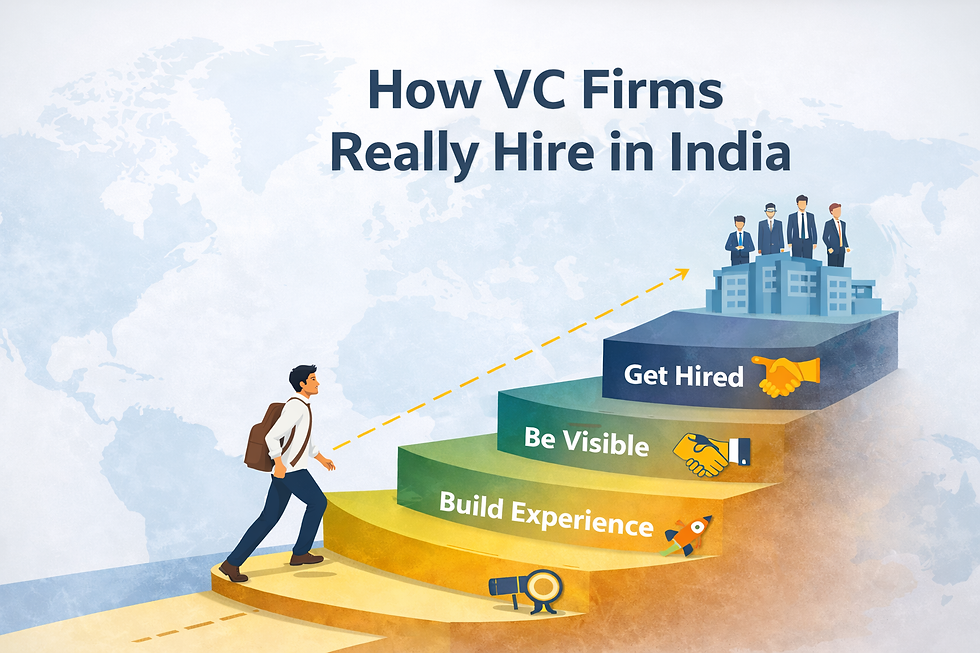
The hiring process is tough, opaque, and slow but none of this means that entering venture capital is impossible or reserved for insiders. What it does mean is that VC hiring rewards a very specific kind of preparation - one that most candidates never undertake. Those who do eventually enter the industry typically spend time building judgment, learning how investors think, and demonstrating decision-making ability long before a formal role opens up. VC careers are rarely won through a single application; they are built through sustained, deliberate preparation.
For the full realistic guide on building a VC career in India (including detailed paths for students, young professionals, and Global Indians), read our complete overview.
FAQ
Can a fresher get a job in venture capital in India?
Yes, but it's uncommon as a direct hire. The realistic path is through an internship or scouting program (Peak XV Surge, Blume, Antler, and similar) that converts into a full-time offer, or a strong referral from someone the fund already trusts.
Do VC firms in India hire straight out of college?
Very rarely for analyst roles at larger funds. Mid-sized and micro funds are more open to it, especially when a candidate has a visible track record — memos, outreach, or deal evaluation practice — built before applying.
What's the fastest way for a fresher to break into VC in India?
Build a public, visible track record before applying (deal memos, sector research, LinkedIn presence), target mid-sized and micro funds first, and pursue formal internship or scouting programs rather than cold-applying to posted roles.
Comments